
The question of whether the real estate market in Bulgaria is in a “bubble,” whether a burst is imminent, or if it will continue to grow, has been among the hottest topics in the country over recent years. Residential prices reached record-high levels as a result of the continuous boom in the sector. However, to understand where the market is heading, we must look beyond dry statistics and analyze market psychology.
How can we recognize that a certain asset is in a bubble? A surefire sign is the moment when everyone starts talking about it, regardless of their level of financial literacy. Laypeople suddenly begin to feel like experts, justifying their speculative enthusiasm with superficial economic data. What they overlook is a fundamental rule: markets are not always driven by cold logic and fundamental economic indicators. At the heart of every market bubble lie human psychology and two of the most powerful emotions – fear and greed.
The legendary credit investor Howard Marks (co-founder of Oaktree Capital Management) notes in his memos that a true bubble is more of a state of mind than a quantitative calculation. When people cannot imagine flaws in the market argument and begin to believe that “no price is too high” for a given asset, the bubble is already a fact.
Nonetheless, a bubbled asset can continue to inflate, and its price can grow long after logic has left the equation. The famous economist John Maynard Keynes has an iconic thought: "Markets can remain irrational longer than you can remain solvent." The bubble is inflated precisely by the momentum of the crowd. When fundamental logic disappears, the market is driven solely by psychological impulse.
The Specifics of the Bulgarian Market and the “Cult of the Brick”
From the perspective of the current situation in the Bulgarian real estate market, this rule applies with full force. The lack of sufficient financial literacy, combined with the deficit of familiar alternative investment assets, pushes the mass consumer toward the safest haven in the collective consciousness – “the brick” (real estate). This is the asset that the average Bulgarian can “see and touch.”
This phenomenon is deeply encoded in several specific factors:
- Historical Memory: During the transition period (1996 - 1997), Bulgarians experienced bank failures and hyperinflation. In the nation's consciousness, stocks, bonds, and mutual funds are often perceived as "virtual" or risky, while real estate provides physical security.
- Lack of Alternatives and Low Interest Rates: For many years, zero or even negative interest rates on deposits, combined with high inflation, literally forced people to "rescue" their money. Due to a lack of knowledge about capital markets, the only logical harbor turned out to be real estate.
- The Bulgarian “Neighbor Syndrome”: Prices in our country are widely determined on the principle: “If my neighbor's property is at such a high price, why shouldn't I sell mine expensively too?” This auto-suggestion completely ignores fundamental factors like location, infrastructure, and the actual condition of the building.
Changing this mindset takes time and will likely be noticeably felt only with the generational shift. Younger generations (born after the 90s and 2000s) are digitally and globally oriented, beginning to invest in stocks, ETFs, and cryptocurrencies. However, the influence of the older generation, which holds the primary capital in the country, still dictates the market. The new mentality and digital financial culture are yet to weaken the grip of the traditional property cult on the market.
And while this psychological anchor is particularly pronounced in Bulgaria, it is not an isolated phenomenon. At its core, it is a universal human mechanism: all over the world, when the masses are driven by the fear of inflation and greed for quick profit, reason gives way to momentum – whether it's apartments in Sofia, stocks on Wall Street, or tulips in Amsterdam. The difference is only that in developed economies (like the US), over 50-60% of people have cultural and easy access to capital markets, whereas in our country, this percentage is minimal.
Psychological Phenomena Under the Magnifying Glass
The thesis that emotions govern market cycles is scientifically proven through several behavioral concepts:
- The FOMO Effect (Fear of Missing Out): The psychological “fear of missing out” is the engine of mania. People often experience greater pain from watching their acquaintances get rich from real estate than from the risk of losing their own money. This completely shuts down rational thinking.
- The Greater Fool Theory: Buyers acquire an overpriced asset with the belief that crowd psychology will allow them to quickly resell it to someone else – an “even greater fool” – at an even higher price.
- The Fear & Greed Index: This tool quantitatively proves that markets move cyclically between extremes. When the market enters the zone of “Extreme Greed,” it almost always portends a subsequent correction.
- Historical Precedent (The Shoeshine Boy Index): According to legend, in 1929 Joseph P. Kennedy withdrew his capital from the stock market because the boy who shined his shoes started giving him advice on which stocks were “safe.” When the mass consumer with no experience begins to hand out investment advice, the market is near a turning point.
The Clash on Two Fronts: Investment Speculation vs. the End-User Buyer
The current market situation presents fundamentally different challenges to participants depending on their goals, dividing them into two main fronts: those who buy to increase, renovate, or preserve personal wealth (often utilizing substantial bank leverage), and those who acquire a property simply to meet basic housing needs.
Here is how their perspectives diverge and who is exposed to the greatest risk in a bubbled market:
The Capital Front: Investors, Speculators, and Renovators
For the professional investor, emotion has no place in the market. They are interested in rental yield, liquidity, and real value. When property prices grow disproportionately fast compared to rents, the math stops working. The investor knows the words of Howard Marks: “Good investing doesn't come from buying good things, but from buying things well (at the right price)”. Therefore, in periods of euphoria, the prudent investor simply stops buying and goes into wait-and-see mode.
However, on the same front are speculators, small-scale renovators (flippers), and “inexperienced” buyers seeking rapid wealth generation. This group is extremely vulnerable during the cooling and sobering phase of the market due to two reasons:
-
The Greater Fool Theory in Action: Those who buy with the goal of a quick resale after a cosmetic renovation rely entirely on prices continuing to rise by momentum. When the market reaches a plateau or liquidity drops, they get "trapped" with overpriced assets that they cannot sell quickly to cover their expensive bridge loans.
-
The Problem of Drying Yields: Those who buy for rental purposes at the peak of the euphoria discover that rents do not grow proportionally to the price per square meter. Thus, the generated cash flow proves insufficient to cover mortgage installments, turning the asset into a pure liability.
The Front of Life Necessity: The Average Buyer for Living
Unlike the investor, the buyer of a primary home is pressed by real-life circumstances and is most vulnerable to market psychology. They are often swept away by the wave of FOMO, fearing that if they do not buy “now,” prices will jump even higher and they will be left without a home. Because they buy with emotion, they easily accept the argument “no property is too expensive when it's for living,” and are prone to making dangerous compromises with their personal budget.
This segment suffers the heaviest and most irreversible blow from a market bubble because of three key traps:
-
Lack of Choice and Market Pressure: Unlike the investor who can exit the market, the end-user buyer does not have the luxury of waiting for years. They are forced to buy at peak levels.
-
The Trap of Maximum Leverage: Driven by psychological pressure, this buyer enters long-term credit obligations (for 20-30 years) that drain the maximum capacity of their family budget. In the event of an interest rate hike or an economic slowdown, they have no financial buffer and face the threat of losing their home.
-
Psychological Enslavement (Negative Equity): If the market corrects prices downward, the investor records an accounting loss, but the end-user buyer remains locked in a property that is actually worth less than the remaining balance on their bank loan.
Who is the Ultimate End-Consumer and Who Loses the Most?
In this complex real estate ecosystem, the true end-consumer is the one who remains to own and use the property in the long term – i.e., the buyer for living. All other participants in the chain (brokers, speculators, off-plan investors) are simply trying to extract a dividend during the upward movement and pass the “hot potato” on in time.
If we must point out who is most severely and painfully affected by the current situation, it is undoubtedly the average buyer for their own needs.
While speculators and landlords risk their surplus capital and business profits (their risk is entirely entrepreneurial), the ordinary person stakes their financial stability for decades to come. A market bubble artificially raises the bar for access to a basic human need – a roof over one's head – turning it into a speculative luxury and forcing the end-user buyer to pay the highest price for the irrationality of the crowd.
2025: Between Euphoria, Records, and Credit Pressure
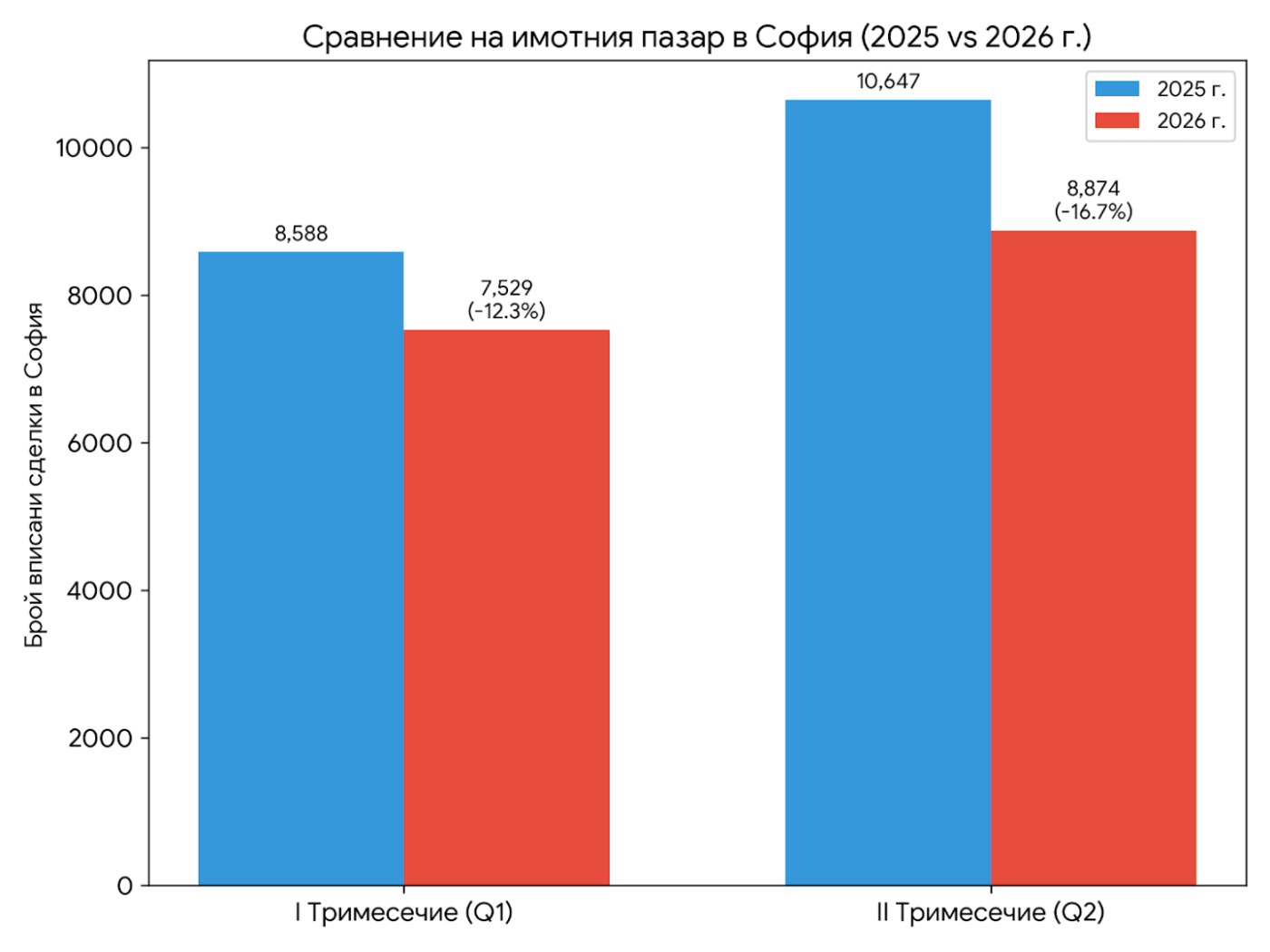
The analysis of data from the previous year, 2025, shows how these psychological stages unfolded in practice. After a brief lull at the beginning of the year, the second quarter of 2025 brought powerful growth, marked by 10,647 recorded transactions in Sofia. Buyers seemed to adapt to the high levels, and the sense of economic stability along with expectations of entering the Eurozone acted as a psychological catalyst.
The main driver of this boom was record mortgage lending. The average loan size reached levels between €200,000 and €260,000. People rushed to buy out of fear of future interest rate hikes, believing that the property market could only move upwards.
2026: The Sobering and Cooling Phase
However, official data from the Registry Agency for the first half of 2026 shows that macroeconomic gravity always brings markets back to reality. A clear phase of cooling and normalization compared to the record-breaking previous year is being observed in Sofia.
| Period | Number of Deals in Sofia (2026) | Year-on-Year Comparison (vs 2025) |
|---|---|---|
| Q1 (First Quarter) | 7,529 | ↓ Drop of 12.3% (compared to 8,588 in Q1 2025) |
| Q2 (Second Quarter) | 8,874 | ↓ Drop of 16.7% (compared to 10,647 in Q2 2025) |
| Total for the Half-Year (H1) | 16,403 | ↓ Total contraction of transaction volume |
Key Trends in 2026:
- Withdrawal of Cash Buyers: The primary drop in volume comes from people with available cash. This proves that purely speculative investment interest is beginning to fade.
- High Dependence on Credit: Despite the drop in transactions, the share of purchases with bank financing in the capital reaches around 65%. The market is now sustained almost entirely by borrowers.
- Price Stabilization: The dynamics are hitting the brakes, but prices are maintaining the plateaus reached without sharp crashes. The market is returning to a calmer rhythm for negotiations and viewings.
The Battle for Storage of Value: New Construction vs. Old Panels
In the context of the changing market, the question of which type of property will preserve its value over the coming decades becomes key. Here, the difference between old panel construction and modern new construction is drastic:
- Old Panels: Although at the peak of euphoria panels in peripheral neighborhoods were sold at prices close to those in the city center (under the influence of the “copy the neighbor's price” principle), long-term they carry serious risk. The amortization of common areas, the expiring operational lifespan of structural connections, the lack of energy efficiency, and poor infrastructure in old residential complexes make them vulnerable to market corrections. They struggle to retain value over a 20-30 year horizon.
- New Construction: Projects with high-quality execution, modern thermal and sound insulation, settled infrastructure (or potential for such), and controlled access are the assets that actually preserve the purchasing power of money. Even during temporary market downturns, quality new construction recovers first, as it offers a standard of living that panel blocks simply cannot provide.
How Should Market Participants Behave?
History shows that when corporate profits or rents grow at a moderate pace while asset prices shoot up by 20-25% per year, risk increases. In the real world, “trees don't grow to the sky.” In the current changing market in Bulgaria, both buyers and sellers must alter their strategies to adapt to the new reality.
Guidelines for Buyers: From Euphoria to Pragmatism
-
An End to Panic Buying: The time of buying “at any cost” is over. The market in 2026 gives you peace of mind. Look around carefully, filter out properties whose price is inflated solely on the basis of “the neighbor's offer,” and negotiate wisely.
-
Beware of the 65% Credit Trap: Since the market is heavily dependent on bank financing, any change in the interest rate policy of the ECB and the BNB will be sharply felt. Do not stretch your budget to its absolute limit. Calculate your installments so that you can service them even in a stress situation or economic slowdown.
-
Focus on Quality That Will Age Slowly: Instead of buying a compromised, aging asset at an artificially inflated price, target high-quality new construction in a good location. It will protect your capital over the coming decades.
Guidelines for Sellers: The Time for Experiments is Over
To successfully close a deal in the market cooling stage, sellers must abandon the inertia of previous years and approach the process with a high degree of professionalism:
-
Realistic Pricing Instead of Speculative Experiments: The time when an arbitrarily high price could be set with a “just in case someone bites” mindset has passed. Today's market requires deep preliminary analysis and setting a price based on actually concluded transactions, not on asking prices in property portals. Overpriced properties risk sitting for months and becoming psychologically “worn out” in the eyes of buyers.
-
A Critical Approach to Marketing and Presentation: Buyers are now much more selective. High-quality photography, home staging, detailed descriptions, and targeted advertising are no longer a luxury, but a mandatory requirement to attract serious interest.
-
Readiness for Negotiations and Flexibility: Sellers must enter the process with a mindset for real dialogue. In cooling conditions, flexibility and readiness for reasonable price adjustments during negotiations are often the difference between a successful deal and a missed opportunity.
The advantage in the market is slowly shifting from the side of the sellers to the side of the rational, informed, and pragmatic buyer. In this new environment, the winners will be those participants who act as pragmatists, rather than victims or hostages of emotions.
In conclusion, on the threshold of the new market reality, we can say that the analysis of the real estate market in our country clearly shows we are witnessing a transition period — from the euphoric and emotion-driven record mortgage lending in 2025 to a phase of natural cooling and sobering in 2026. The figures from the Registry Agency confirm that macroeconomic gravity is beginning to regain control over the market, bringing a calmer pace and higher demands regarding asset quality and the professionalism of sellers.
Despite clear signs of a slowdown, it is important to emphasize that this analysis does not aim to make definitive predictions about specific price movements in the coming years. On the contrary, as the history and theory of market cycles prove, the behavior of the masses often remains unpredictable. Even when an asset is in a state of a bubble, it has the potential to continue bubbling, and its prices can rise by momentum, driven by the deeply rooted "cult of the brick" and the lack of a financial alternative in the collective consciousness.
In an environment ruled simultaneously by dry numbers and strong human emotions like fear and greed, no one can predict with absolute accuracy when the psychological impulse will yield entirely to fundamental logic. The only sustainable solution for every individual participant in the market — be it a buyer, investor, or seller — is to avoid the traps of mass psychology (such as the FOMO effect or blindly copying "the neighbor's offer").
Instead of trying to outsmart the market or guess its absolute peak and bottom, the wisest move is to make informed decisions based on a cold-blooded analysis of the situation, a clear assessment of personal financial buffers, and a deep understanding of potential risks. Furthermore, the property market is never completely homogeneous: every property represents a strictly individual opportunity. Even in moments of general cooling or a bubble, a given property may possess far better specific characteristics, location, and real value compared to other offers. This makes it a potentially excellent and justified deal, regardless of the current state of the macro framework. In the end, markets change, but pragmatism, detailed selection, and quality remain the best defense for any capital.

Selling a Property?
We will help you sell your property quickly and at the best price.
Share Our Article
 Facebook
  X
X  LinkedIn
  Instagram
This article is strictly for informational purposes and does not constitute a recommendation to buy or sell real estate. All “materials” (including photos, graphics, texts) are the property of our company and are protected by the Copyright Act of the Republic of Bulgaria. When copying “materials,” the general terms and conditions of use apply.